
The THBR Crucible: Hallucinations, Blackouts, and Survival at the Bali Trail Ultra

A mountain does not care about discipline. It does not care about taped knees, early alarms, or the months of quiet suffering logged on flat city tarmac.
For the Hulu Balang Runners (THBR), a Malaysian tribe forged in the strict routine of 4 AM urban training, the Bali Trail Ultra offered a profound and ruthless audit of this reality.
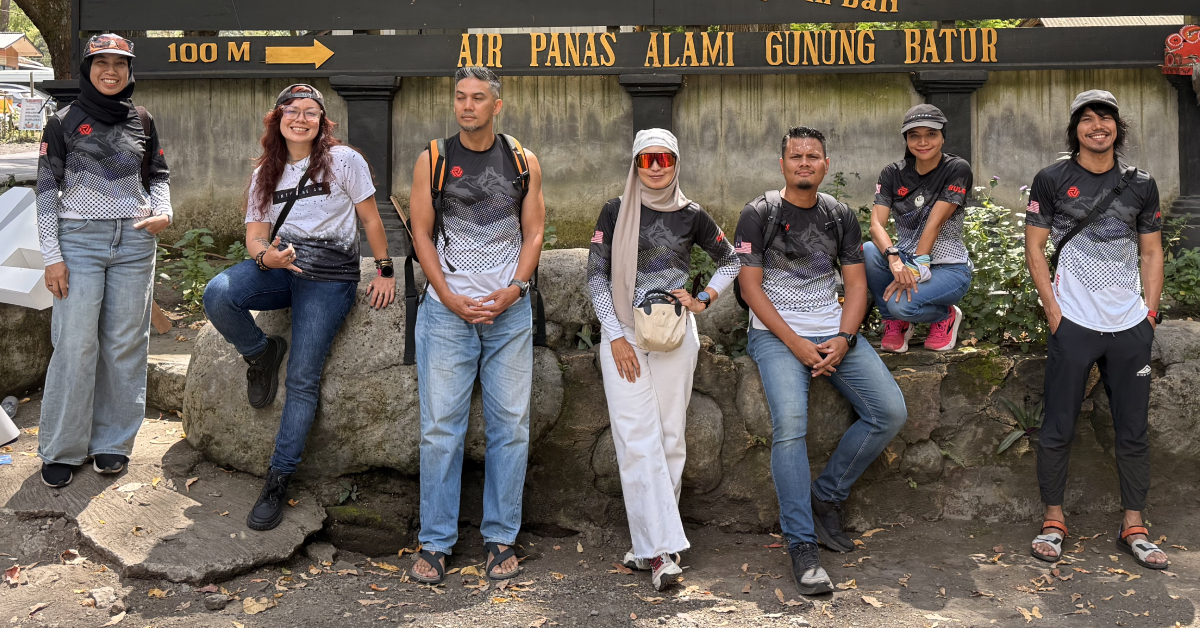
In mid-May 2026, seven athletes from the collective stood at the foothills of Mount Batur, Mount Abang, and Mount Agung. They arrived carrying the calculated confidence of runners who had mastered their daily routines. But the volcanic trails of Kintamani demand a different currency.
Here, physical fitness is merely the entry fee; survival requires a primal, psychological resilience.
The illusion of control is often the first casualty on the mountain. In the 30-kilometre category, Monina Mahmood found her meticulously planned race dismantled within the first kilometre. The jagged, unforgiving black lava fields instantly reawakened an old ankle injury. On a flat section with barely any elevation, she found herself reduced to a painful stumble. The physical setback triggered a sharp emotional crash.
“I felt like crying because it felt like such a waste of time,” she confessed. The solution was not found in athletic prowess, but in psychological pivot. Remembering that her teammates were enduring far worse on the longer routes,
Monina abandoned the concept of a graceful race.
It became an exercise in raw damage control. It took her over an hour to cross five kilometres of rock, a grueling stretch fueled entirely by a refusal to let the terrain defeat her spirit.
As the elevation increased, the mountain began to wage war on the mind. During the 60-kilometre event, the sheer scale of the landscape turned into a psychological weapon.
Exhausted on a steep ascent, Mira Noor Ambu Spaniol collapsed onto the grass. Looking up, she found fleeting comfort in what appeared to be a starry night sky. The relief was violently erased when she realised the “stars” were actually the headlamps of competitors navigating switchbacks in the heavens above her.
“At that moment I felt defeated,” she recalled. Yet, knowing that staying on the ground would not alter her reality, she forced her legs into motion, adopting a grim determination to “reach for the stars.”
Further into the darkness, Hairani binti Zainal faced a similarly bleak internal landscape. Trudging up an endless, winding ascent bathed in hot, intermittent winds, she was forced to watch other runners simply stop and surrender.
The temptation to join them was immense, draining her both physically and mentally. The only countermeasure was a stubborn, rhythmic mantra: what goes up must eventually come down.
Her teammate, Farahana binti Sulaiman, found herself locked in a similar internal negotiation. Fighting the relentless urge to quit amid the punishing elevation, Farahana realised the mountain offered no easy way out.
Her only options were a voluntary withdrawal or missing the cut-off time entirely. That stark reality forced a blunt mental ultimatum. “Choose your pain,” she recalled. It was a choice between the temporary agony of moving forward and the lasting sting of giving up.
To survive the 100-kilometre category, however, an athlete must push past exhaustion and enter a state of sensory deprivation. After 33 hours and nearly 7,000 metres of climbing, Ahmad Amzar bin Omar reached the 98-kilometre mark. His mind was already blank. Then, his headlamp died. With his phone battery critically low, he navigated the final, treacherous descent using only the faint, dim glow of his mobile wallpaper screen.
“That moment taught me something,” he reflected. “Sometimes you don’t need to see the whole path to move forward. You just need enough light and enough belief to take the next step.”
This blind faith was mirrored by THBR founder Rahazliman bin Rakman, who found himself navigating narrow, exposed cliffsides in the dead of night.
Sweating heavily despite the freezing altitude, the sheer drop forced him to crawl or cling to the terrain, keeping his eyes locked strictly forward to manage the rising panic.
As a leader, he carried the silent pressure of his tribe’s expectations, but on the cliff edge, the motivation distilled into something purely personal. It was no longer about proving a point; it was about honoring the quiet, unseen sacrifices made to get to that exact edge.
Sometimes, despite every sacrifice, the mountain simply says no. For Mohammad Farid Othman in the 60-kilometre race, the end came not from a lack of will, but a lack of time.
Soaked from the rain and trembling from endless muddy descents, he looked at his watch on Gunung Abang and realised the cut-off time had slipped away.
In that singular, empty moment, months of forcing himself to train while injured crashed down on him. “I remember looking around Gunung Abang thinking: ‘The mountain doesn’t care how badly you want it,'” he stated.
Yet, this harsh truth did not break the tribe; it recalibrated them. The Bali Trail Ultra proved that there are depths of suffering that city training can never fully simulate.
Returning to the pavement of Kuala Lumpur, the rigid discipline that defines THBR remains, but the perspective has shifted completely. For athletes like Othman, the grueling pre-dawn alarms are no longer a sacrifice.
“Now, 4 AM feels peaceful,” he observed. “Those 4 AM mornings were not wasted. They were the only reason I made it as far as I did. So now when I wake up at 4 AM, I no longer see punishment, I see unfinished business.”


