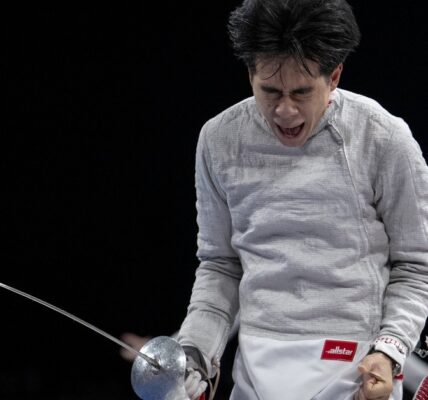
‘One Last Bout’: Singapore’s Ashton Auw on Recovering From a Semi-Final Loss to Win Dakar 2026 Sabre Bronze

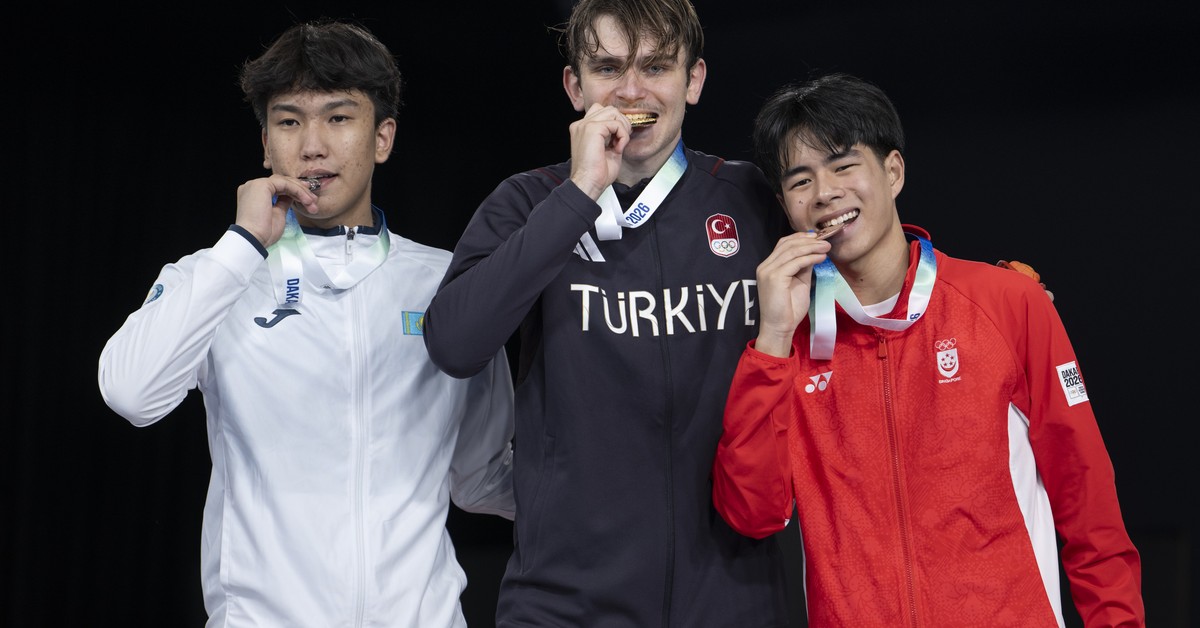
Singapore’s Ashton Auw told ToughASIA that he started doubting his attack in his Dakar 2026 Youth Olympic Games semi-final, then kept telling himself “one last bout” on the way to men’s sabre bronze.
The 17-year-old won all six of his pool bouts on 13 November at the Dakar Expo Center and finished first of the 13 fencers in the pool round. He lost the semi-final 15-13 to Kazakhstan’s Aibar Kaiym, then beat Georgia’s Giorgi Urushadze 15-10 in the bronze medal bout.
Auw said his main idea on arriving at the venue was to enjoy the moment and fence as well as he could. In his pool he beat Turkey’s Candeniz Berrak 5-1 and Kaiym 5-3. Berrak went on to win gold and Kaiym silver.
“Eventually after beating the best two people in my poule, I was definitely feeling super pumped up and I really believed that I was in good form that day,” he said.
In a video posted by the Singapore National Olympic Council after his bronze, Auw said he went into the competition believing there was “no one that I cannot win”. He told ToughASIA where that belief came from.
“I got that belief from two people, one of which came from my mom, where she constantly reminds me that anything can happen in competition, and secondly was my coach, who constantly reminds me that I am a strong fencer myself and I should not be afraid of anyone, especially in the competition itself, as every bout is a new bout,” he said.
Auw said he worked out Kaiym’s style in their five-point pool bout faster than Kaiym could adapt, but the 15-point semi-final went differently.
“I started doubting my attack and ended up on defence a couple of times or even missing my attack after getting the priority due to me rushing and doubting myself,” he said. “I definitely need to work on my confidence at crucial moments and to always remain sharp, especially nearing the end of a close bout.”
He said he felt dejected after the loss, reflected on his mistakes and focused on not repeating them in the bronze medal bout.
“This was also my last bout of the competition and I told myself that I have nothing to lose, and so I just fenced my heart out down to the very last point,” he said. “I waved off any negative thoughts and kept telling myself ‘one last bout’.”
Auw led Urushadze 8-6 at the end of the first period. “In the first period, my main plan was to take over the attack as much as possible by using my strengths and playing my game,” he said.
During the one-minute break, he went back over the points he had won and used them in the second period, “allowing me to slowly inch the score away to victory”.
Right before the Youth Olympic Games, Auw lost to a teammate in the round of 128 at a Junior World Cup.
“It was an unlucky path and I was indeed very disappointed, but I told myself that I should just take away the things that I can learn from and move on to the next competition,” he said. “You cannot always win, and I learnt just as much if not more from losing than winning.”
During a bout, he said, he focuses on his strengths and the action he wants to execute, and adjusts to the opponent. “I cannot dictate what my opponent is going to do, but I can decide what I want to do or what I want them to do and execute accordingly,” he said.
He called Dakar “a once in a lifetime experience” and said living in the Olympic Village is one of his core memories, as he met a lot of new friends from different sports and got closer to his own competitors.
“Having friends off the piste is definitely very important to me as this will be the group that I grow up with in the sport,” he said.
Auw named his mother first among the people who have helped him, supporting him from wushu in primary school to fencing in secondary school. “She is my biggest pillar of support,” he said.
He also thanked his coaches, Coach Seungjun and Coach Eric Brando, who he said have guided him step by step in training, and his seniors, who have given him advice in fencing and in life.
Auw said he hopes to achieve something in the junior (under-21) category, in Asia and on the world stage.
“I also hope to qualify and represent Singapore in the upcoming SEA Games 2027 in Kuala Lumpur as well as [win] a medal in the 2029 SEA Games in Singapore,” he said. “One of my long term goals would be to qualify for the Olympics, and although challenging, I believe that with enough hard work, anything is possible.”
His advice for young fencers who want to follow him, and what he would have told his younger self, is to always think about what there is to learn, even after a bad competition.
“One bad competition does not determine your future if you choose not to let it,” he said. “Keep on looking ahead at the bigger picture and dream big, because one day that dream may just come true.”