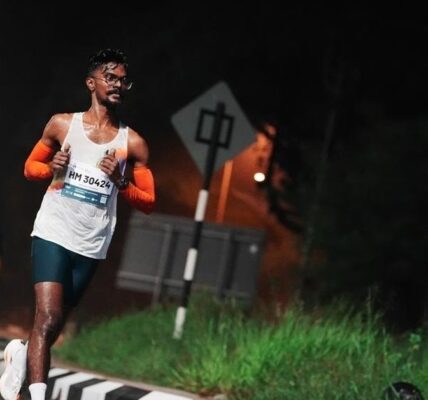
Nearly a Non-Starter After a School Open Day, Hazarullah Safri Runs 2:43:45 for Second at the RSAWIT Marathon


Teacher Hazarullah Safri spent the day before the RSAWIT International Marathon at his school’s open day, came close to not starting, and then ran the 42km in Sibu in an official net time of 2:43:45, finishing second, he said.
The full marathon started at midnight, the first time he had raced at that hour. He had been at a school programme, a hostel open day, from 8am to 5pm, and had no time to sleep.
“I felt it would be a real waste not to even try to run, even though I knew I had no time to rest, because I started thinking about how long I had trained for this race,” Hazarullah told ToughASIA. “It feels like such a waste when you train for weeks and months and then suddenly decide not to start.”
Before a 1am start he would usually eat his last heavy meal at 5pm or 6pm and sleep in the afternoon and again in the evening. This time, he said, he lived on electrolyte drinks and biscuits all day, with no heavy meal, and only managed to lie down briefly before getting ready to race.
He realised he was second after 30km, when the runner ahead began to pull away as he dropped off slightly. By his estimate, he finished about 17 to 18 minutes ahead of the third-placed runner.
Over the closing kilometres he slowed, but he said nothing serious had gone wrong.
“My legs were still in good condition and my breathing was still fine,” he said. “My body just felt quite exhausted, not like the full marathons I’ve run before.”

The 2:43:45 is not his personal best, which is 2:43:38 at the KL Standard Chartered Marathon 2026, he said.
His twin, Syahrullah, also ran in Sibu. Hazarullah took up running in 2018 by following his twin, who was already active in the sport, and became serious about the marathon in 2019, starting with the Kuching Marathon. The two agree a pace and take turns leading so one can shelter from the wind, and keep each other going with words of encouragement.
His training has not changed much from last year, he said, except that he now does two high-intensity sessions a week, on the same 130 to 140km weekly mileage. He trains after school hours, travelling 40 to 45 minutes to train in Bintulu every day, and does his long runs at weekends.
“For me, being a teacher and a long-distance runner go hand in hand, because both teach me to be more patient, consistent and resilient, and to keep working towards my goals,” he said.
His next target is a sub-2:40 marathon, and his next race this year is the Penang Bridge International Marathon.
“What matters to me is to keep trying, learn from every race and challenge myself to become a better runner,” he said.